
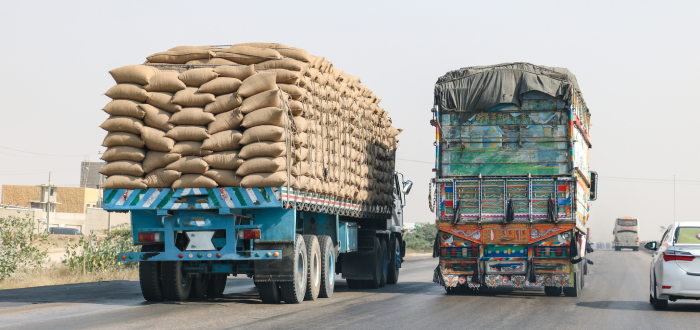

A driver heading down the interstate sees the truck ahead of them sway through a curve. A piece of the load shifts. Then a strap fails, and a section of cargo comes loose, tumbling into the right lane. The driver behind has half a second to react.
Most drivers who end up in a crash with a commercial truck never thought about how the load was packed. They were thinking about the truck. But the load is part of the truck, and when the load is wrong, the truck behaves in ways drivers around it cannot predict.
What “Overloaded” Actually Does to a Truck
Federal cargo securement rules in 49 CFR Part 393 set the weight a truck and its securement system must be able to handle. When a load exceeds what the truck or its tie-downs are rated for, the failure points are not random. They are predictable.
Tires carry the first cost. A loaded axle generates heat, and an axle carrying more than its rated weight generates more heat than the tire is designed to dissipate. Heat softens the rubber, weakens the casing, and pushes a tire toward blowout. A blowout on a loaded tractor-trailer at highway speed is not a flat. It is a sudden change in handling that the driver must correct in seconds.
Brakes carry the second cost. A truck’s braking system is engineered for the maximum legal weight. Above that weight, the brakes still work, but they work with less margin. They run hotter through long downgrades. They take longer to recover after hard application. By the time a driver realizes the brakes are fading, the crash has already started.
Frame and suspension components carry the third cost. They flex and fatigue under loads they were never designed to hold. The damage is invisible from the road, and it shows up months later as a part that breaks at the wrong moment.
In the cargo cases we have handled, overloading is rarely a single dramatic event. It is a chain of small compromises: an extra pallet here, a heavier coil than the bill of lading shows, a shipper rushing to clear the dock. Tracing those compromises back to a responsible party is part of what a truck accident attorney in Macon does early in a case.
Why Where the Weight Sits Matters as Much as How Much
A truck can be under its weight limit and still fail because of where the weight is sitting.
Every commercial vehicle has a center of gravity. When the cargo is packed low and balanced, that center sits low and stays put through turns. When the cargo is stacked high, or loaded heavy on one side, the center rises or shifts. The truck still drives normally on a straight road. The problem appears in curves.
Engineering studies of heavy trucks place rollover thresholds in a range of roughly 0.25 to 0.5 g of lateral acceleration. That number is much lower than passenger cars, which is why passenger cars typically slide before they tip and trucks typically tip before they slide. A loaded tractor-trailer rounding a ramp has very little margin between holding the curve and going over.
Speed makes that margin smaller, fast. Centrifugal force in a turn rises with the square of speed. Double the speed entering a curve and the force trying to push the truck outward quadruples. A high center of gravity that was stable at 35 mph can be enough to roll the truck at 50.
Weight on the wrong axle adds another failure mode. Too much weight on the steering axle changes how the truck responds at the wheel. Too little weight on the drive axle reduces traction and braking authority. In the cases we have looked at, drivers rarely think about how the load was distributed until something goes wrong.
What Happens When Cargo Doesn’t Stay Put
Cargo securement is not optional and it is not approximate. Federal rules require a securement system to hold against 0.435 g of forward deceleration, 0.5 g of rearward acceleration, and 0.5 g of lateral movement. The aggregate working load limit of all tie-downs must be at least half the weight of the cargo. Articles five feet or shorter need at least one tie-down. Articles between five and ten feet need at least two. Anything longer needs an additional tie-down for every ten feet beyond that.
When those numbers are not met, the cargo can move. And once cargo starts moving on a truck, three things happen at once.
The first is handling loss. A load shifting to one side during a turn pushes the truck the same direction it is already leaning. The driver fights the truck instead of steering it.
The second is momentum transfer. A heavy load sliding forward during a hard brake adds its weight to the cab’s forward momentum. The truck does not stop where the brakes alone would have stopped it. It stops several feet farther on, often into whatever made the driver brake in the first place.
The third is what the driver in our opening saw. A failed strap, a load that breaks containment, cargo on the road behind the truck. The truck driver may not even know it happened until traffic behind them starts swerving.
If you or a family member has been hurt in a crash involving a truck whose load failed in any of these ways, Gautreaux Law has handled cargo-related truck accident cases across Georgia for more than 20 years. You can speak with a Macon truck accident lawyer for a free case review.
“No fee unless we recover” refers only to attorney’s fees. Court costs and other case expenses are typically advanced by our firm and reimbursed from any recovery. Contingent fee arrangements are not permitted in all types of cases. Past results do not guarantee a similar outcome. Each case is different and depends on its specific facts and circumstances.