
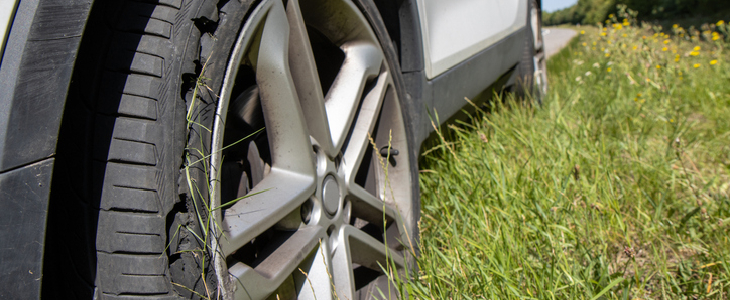

A shredded tire after a crash can make the explanation seem obvious: the tire failed, so the tire must have caused the wreck. The physical evidence is not that simple.
A tire may fail before a driver loses control. It may be damaged by a pothole, curb, debris, or another impact moments before the collision. Long-term pressure loss, wear, overloading, or an earlier repair can weaken a tire over time. The crash itself can also destroy a tire that was intact before impact.
A product defect is another possible path. A problem in a tire’s design, materials, or manufacture can affect how the tire performs under normal driving forces. Determining which path occurred requires more than finding a flat or damaged tire at the scene.
For a driver or passenger trying to understand a serious tire-related crash, three questions matter: what failed, when it failed, and what explains the failure.
What Does “Defective Tire” Mean?
In everyday language, people often call any tire that comes apart “defective.” From an investigation standpoint, that term needs more precision.
A tire can fail because of a condition in the product itself. It can also fail because of underinflation, excessive loading, age, impact damage, installation, repair, or maintenance. Some crashes involve more than one factor.
The legal question of whether a tire qualifies as a defective product is separate and depends on the evidence and applicable law. Gautreaux Law addresses that framework on its defective product and product liability page. Mechanically, the first question is how the tire reached the condition that preceded the crash.
Why the Failure Sequence Matters After a Crash
Suppose a vehicle leaves its lane and the tire is found destroyed afterward. At least three broad sequences can produce that scene, and more than one can overlap:
-
The tire failed first. A loss of tire performance contributed to the driver losing control.
-
An impact damaged the tire first. The vehicle struck a pothole, curb, debris, pavement edge, or another object, damaging the tire and changing the vehicle’s path at nearly the same time.
-
The tire was damaged during the crash. The vehicle lost control for another reason, and the tire was destroyed as the collision unfolded.
Those sequences can leave similar debris and vehicle damage. They do not point to the same cause.
This is why Gautreaux Law’s tire blowout accident page focuses on preserving the tire and vehicle, determining whether the failure came before or after the loss of control, and identifying the people, companies, products, maintenance decisions, roadway conditions, or other factors that may have contributed.
Tread and Belt Separation Can Change How a Vehicle Handles
A radial tire is built from multiple layers and components that have to remain integrated while the tire flexes, heats, turns, brakes, and carries load. One significant failure mode is separation in the tread and belt area.
A separation can develop gradually. If it progresses, portions of the tread or belt package can detach. That change can reduce the tire’s ability to transmit steering and cornering forces to the road.
A tread separation does not necessarily mean that the tire instantly loses all air pressure. The sequence can differ from one failure to another. Investigators may therefore examine the remaining carcass, detached tread or belt material, the wheel, and the vehicle rather than treating every reported “blowout” as the same event.
NHTSA’s TireWise guidance explains that sustained high temperature can cause a tire to deteriorate, leading to blowouts and tread separation. That makes heat one condition worth examining when a separation is investigated, but it does not establish that a particular tire was defective. Inflation, loading, age, damage, maintenance, and other conditions still have to be considered alongside the physical tire and the crash sequence.
Sidewall and Bead Damage Can Have Different Origins
The tread is only one part of a tire. The sidewall flexes as the tire rotates, while the bead helps keep the tire seated against the wheel. Damage or a structural problem in either area can contribute to air loss or to structural failure of the tire.
The final appearance may not reveal where the problem began. A sidewall can be damaged by road impact. A bead can be harmed during mounting or other service. A manufacturing problem can create a different path to a similar-looking failure.
Photographs have limits. A photograph can document what remained after a crash, but it may not establish whether a condition began during production, developed during service, followed a road impact, or occurred during the collision itself.
Manufacturing Problems Are Different From Wear and Maintenance
A manufacturing problem concerns what happened while a tire was being produced. The relevant question is whether something about the materials, assembly, bonding, or construction of a particular tire or production group differed from what was intended.
Wear is different. So is extended driving on an underinflated tire, damage from a prior impact, or an incorrect repair or installation.
Those distinctions matter because a failed tire can sit at the intersection of several explanations. If the evidence points toward maintenance, inspection, repair, or a vehicle owner’s decision to keep an unsafe tire in service, the issue moves away from product condition and toward vehicle maintenance. Gautreaux Law discusses that route on its page for accidents involving inadequately maintained vehicles.
The presence of a damaged tire should start the investigation, not finish it.
Design Questions Are Not the Same as Manufacturing Problems
A manufacturing problem generally asks whether a particular tire departed from the product that was supposed to be made. A design question concerns the intended product itself.
That distinction can require technical analysis of the tire’s construction, intended performance, operating conditions, and the failure that occurred. A separation, blowout, or pressure-loss event does not, by itself, point to a design problem.
The product-liability issues that follow from a design or manufacturing theory are separate from the physical failure sequence discussed here. For a tire-failure investigation, the immediate task is identifying the physical failure path before assigning a legal label to it.
Recalls and Defect History Can Add Context
A safety recall can be important when a tire failure is being investigated, but it does not answer the entire causation question.
NHTSA lets consumers search tires and other vehicle equipment for recalls and provides access to investigations, complaints, and manufacturer communications. If the tire’s identifying information is still available, you can compare it with those records and save what you find with the other crash documentation.
If a tire falls within a recalled population, investigators still need to determine whether the recalled condition was present in that tire and whether it contributed to the failure. The absence of a recall does not establish that a particular tire was free from a product problem.
Recall information is context. The physical tire and the crash sequence remain central.
More Than One Condition Can Contribute to a Tire Failure
A tire failure does not always fit into a single clean category. A product-related weakness could exist alongside later road damage. A tire with no product problem could fail after a severe impact. An installation or repair issue can create a failure path that has nothing to do with how the tire was manufactured.
Age can be another part of the failure history. NHTSA explains that tire aging occurs as rubber and other components change over time because of service, storage, and environmental conditions. It also notes that warmer climates, poor storage, and poor maintenance can contribute to aging, and that tires become more prone to failure as they age. Age can therefore matter without explaining a particular failure on its own.
That is why road impact, installation, repair, loading, inflation history, age, and the tire’s own condition may all need to be considered before a cause is assigned. The investigation works backward from the failure and tests the competing explanations against the physical evidence.
The opposite error is ruling out a product problem as soon as another possible contributor appears. A pothole strike, prior service, inflation history, or another factor may explain part of the sequence without answering whether the tire also had a product-related condition.
What Evidence Can Help Explain a Tire Failure?
The most useful evidence often extends beyond the failed tire itself. Depending on the crash, an investigation may consider:
-
the failed tire carcass and any detached tread or belt material;
-
the wheel, valve, and other tires from the same vehicle;
-
tire identification and production markings;
-
purchase, installation, rotation, repair, and maintenance records;
-
prior complaints involving pressure loss, vibration, noise, or visible damage;
-
photographs and video from the scene;
-
roadway marks, debris, and impact damage;
-
recall, investigation, complaint, and manufacturer information; and
-
evidence showing how the vehicle moved immediately before and after the suspected failure.
No single item answers every case. The value comes from reading the components, records, and crash sequence together.
If a tire or vehicle from a serious crash is still being stored, do not put yourself at risk trying to recover roadway debris or handle an unstable vehicle. While it is still possible, contact the person or facility holding the tire or vehicle promptly and ask that the relevant components be preserved before they are discarded, repaired, altered, or transferred.
Defect, Maintenance, or Blowout: Which Question Comes First?
The visible event may be a tire failure. The explanation can follow different paths.
If the evidence points toward a problem in the tire as a product, the defective product page explains the legal investigation into product condition and responsible companies.
If the evidence points toward neglected tire condition, missed inspection, or improper vehicle maintenance, the inadequately maintained vehicle page addresses that route.
If the central question is why a tire failed during a collision and who or what may have contributed, the tire blowout accident page is the broader starting point.
Keeping those questions separate helps prevent a damaged tire from being treated as proof of a defect, poor maintenance, or driver negligence before the evidence supports any of those conclusions.
Gautreaux Law Investigates the Cause Behind Tire-Failure Crashes
Tire-related crashes can require the physical components, service history, roadway evidence, and vehicle movement to be examined together.
Gautreaux Law has represented people seriously injured in automobile and commercial-vehicle collisions for more than 20 years and has recovered more than $100 million for clients across a range of personal injury matters. Past results do not guarantee a similar outcome. The firm serves Macon, Warner Robins, and Middle Georgia.
If a tire failure may have contributed to a serious crash, Gautreaux Law can review the circumstances and determine whether the matter fits the firm’s practice. Contact Gautreaux Law to discuss what happened.