
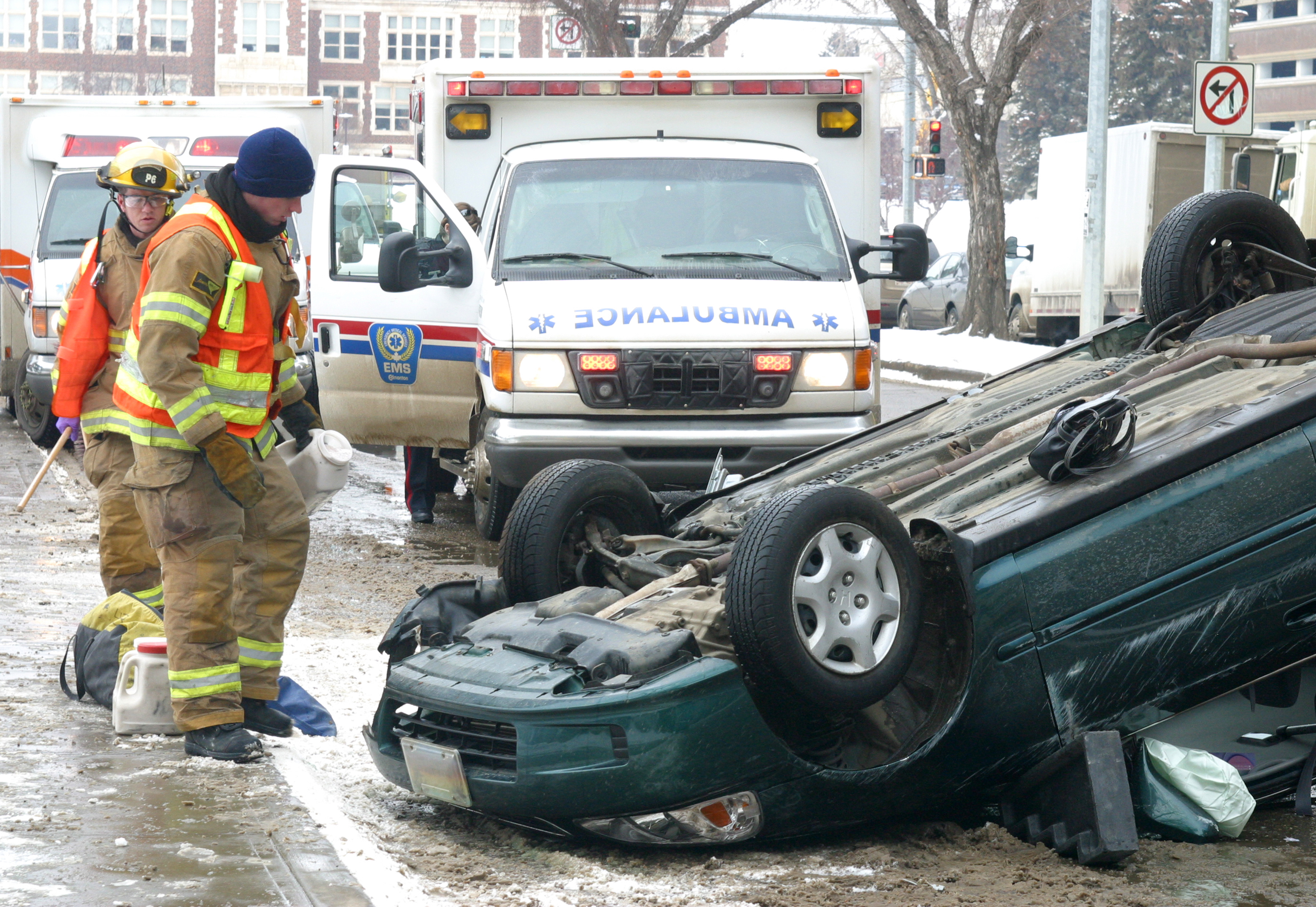
The police report may say you “lost control.” For many insurance companies, that’s where the investigation ends.
For us, it’s where the real investigation begins.
Rollover accidents are among the most violent and catastrophic types of motor vehicle crashes. They often leave victims with traumatic brain injuries, spinal cord injuries, broken bones, paralysis, or fatal injuries. But a rollover does not happen simply because a vehicle leaves the roadway. Every rollover has a physical cause, and understanding exactly why the vehicle rolled is often the key to determining who is legally responsible.
Sometimes a vehicle rolls after striking a curb, guardrail, soft shoulder, or embankment. Sometimes it trips and overturns while sliding sideways. Other rollovers occur without any impact at all because of the vehicle’s speed, steering inputs, loading, or design. In some cases, another driver’s negligence set the entire chain of events in motion—even if there was never any contact between the vehicles.
At Gautreaux Law, we don’t stop with the police officer’s conclusion that a driver “lost control.” We examine the physical evidence, vehicle dynamics, roadway conditions, witness testimony, and crash sequence to determine exactly what happened and whether another person, company, or defective product contributed to the rollover.
If you or someone you love was injured in a rollover accident in Macon, Warner Robins, or anywhere in Middle Georgia, Gautreaux Law has more than 20 years of experience representing seriously injured crash victims. Our firm has recovered more than $100 million for injured clients, and we are committed to uncovering the truth behind even the most complex rollover accident cases.
Insurance adjusters love a simple story: you overcorrected, you ran off the road, end of story. That story describes what your vehicle did — it says nothing about what made it do that. Closing that gap is the entire case, because rollovers cause some of the most severe injuries we see, in files that start out looking like nobody else was involved.
Every rollover falls into one of two categories, and which one applies determines where the evidence lives.
Tripped rollovers: Your vehicle is sliding sideways when something interrupts that movement — a curb, a soft shoulder, a pavement edge, a rut, a guardrail. Because that interruption happens at a specific spot, the scene itself often holds the evidence.
Untripped rollovers: Your vehicle tips over purely from the lateral forces of a hard steering movement or turn, without hitting anything. Here the proof isn’t on the shoulder — it’s in how the vehicle handled and what it was carrying.
Both types start with the same question: what created the loss of stability? Steering, speed, a collision, a roadway defect, shifting cargo, or the vehicle’s own design can all be part of the answer — and it’s usually the question the initial police report never asks. If a tire failure kicked off the sequence, that opens a separate line of investigation; see our tire blowout page.
Vehicle design matters too. A taller vehicle, or one carrying a heavy load up high, has far less margin before it tips than the same vehicle riding empty and low.
Working out exactly what happened — and which driver, roadway, cargo, or vehicle factor caused it — is what keeps a rollover from being written off as “driver error” before anyone’s looked closely.
Most rollovers point toward one of four places. Sorting out which one (or ones) is the first job.
Another driver who never touched you: A car that forces you into a shoulder or across a lane can send you into a rollover without ever making contact. If that driver is identified, the lack of contact doesn’t by itself sink your claim. If they’re never identified, you’re dealing with the insurance industry’s contact-or-corroboration rule — read more on our hit-and-run collisions page and our uninsured and underinsured motorist page. What this page adds is the rollover-specific proof: yaw marks and vehicle path that show you were forced over without ever being struck.
The condition of the road: A pavement edge that drops several inches to the shoulder, or a shoulder that’s washed out or was never built to hold a wheel, can act as a trip point. If a city, county, or state agency was responsible for maintaining that stretch, a claim against them comes with its own notice requirements and shorter deadlines — details are on our Macon car accident attorney page. Whether a public entity can be held liable also turns on who controlled maintenance, what notice they had of the hazard, causation, and applicable immunity rules — exactly why the roadway needs to be examined early, not months later.
A defective vehicle: This is a second lawsuit hiding inside the same wreck, and running the two theories together confuses both. A handling or stability defect may have helped start the rollover. Separately, a crashworthiness defect — in the roof, the restraints, or another safety system — can make your injuries worse than the rollover itself would have caused. Neither is automatic; each requires proof of a defect and its role in your injuries, and both run through our defective product claims process. The evidence lives in the wreckage itself — which is exactly why the vehicle shouldn’t be repaired, sold, or scrapped until it’s been examined.
Whoever loaded the vehicle: If someone other than the driver loaded the vehicle, how that cargo was placed and secured can be part of what caused the rollover. High cargo raises the center of gravity, unsecured cargo shifts mid-turn, and a commercial load brings the loader, the shipper, and their insurance into your case.
Georgia changed an important rule on April 21, 2025. Evidence that an occupant wasn’t wearing a seat belt can now be considered on negligence, comparative negligence, causation, assumption of risk, and apportionment of fault — and it can be used to reduce a recovery, subject to the usual rules of admissibility.
In a rollover involving occupant movement, interior contact, or ejection, seat belt use can become part of both the causation and damages analysis. Not wearing one doesn’t kill your claim on its own — like any other argument, it has to be proven, and we know how to push back on it. Which version of the rule applies depends on when your crash happened, which is exactly the kind of detail that needs to be sorted out at the start of a case, not after.
A rollover leaves an extensive physical record, and most of it sits outside the vehicle itself. Here’s what we do on every case:
Document the scene fast: Retained early, we inspect and photograph the site ourselves. Retained later, we pull the police photos, measurements, and roadway records, and document whatever the site still shows. Tire marks, yaw marks, gouges, and disturbed ground can help reconstruct your vehicle’s path before, during, and after the rollover.
Look for the trip point: A curb, a shoulder drop, a rut, a guardrail — each one changes both the physics and the list of responsible parties. These conditions get repaired or altered fast, so we move fast too.
Preserve the vehicle: We examine the roof, the pillars, and the restraints together, and where the vehicle has a compatible event data recorder with usable data, we get it read. Repair, dismantling, or sale can destroy that evidence — or make the vehicle impossible to find.
Track down the witnesses nobody wrote down: Drivers who were passed, forced over, or who saw your vehicle before it left the road rarely make it into the initial police report — but they can make your case.
Build the medical record: We gather the evidence that establishes your injuries and their course, and where roof intrusion, restraint performance, or enhanced-injury causation is disputed, we bring in reconstruction, biomechanical, or engineering experts.
In nearly every rollover case we’ve handled, the file that opened looking like a routine single-car accident did not stay that way. Where the evidence supports it, we determine whether your rollover was tripped or untripped, what started the instability, and which driver, roadway, cargo, or vehicle factor contributed to it.
We don’t stop at “driver lost control”: That conclusion is where most files end. For us, it’s where the real work begins — figuring out what started the instability, whether a trip point existed, and how the sequence actually developed.
We preserve evidence before it disappears: Roof, restraint, and data evidence can be altered or destroyed the moment a vehicle is repaired, dismantled, or sent to auction. We move on preservation notices and inspections immediately, because waiting costs you the case.
We prepare every case for trial: When the evidence points to more than one contributing cause, a jury may have to weigh each one — and that argument gets built long before trial starts. Gautreaux Law has tried cases across Georgia courts, including Bibb County and other Middle Georgia jurisdictions.
These results come from the firm’s automobile and commercial vehicle collision work. They are not presented as rollover cases, and each turned on its own facts.
| Recovery | Case Type | Outcome |
| $10.5 Million | Automobile Accident, Governmental Liability | Traumatic Brain Injury |
| $1.5 Million | Commercial Van Collision | Wrongful Death |
| $400,000 | Car Wreck | Leg Amputation |
| $180,000 | Car Wreck | Brain Injury |
Each case is different and depends on its specific facts and circumstances. Past results do not guarantee a similar outcome. These figures represent gross recoveries before deduction of fees and expenses.
No. Insurance companies often frame rollovers as simple driver error, but a rollover can be caused by a dangerous road condition, a vehicle defect, cargo that wasn’t secured properly, or another driver who forced you off the road without ever making contact. Determining the actual cause is the first step in every case we handle.
It doesn’t automatically bar your claim. Under Georgia’s current rule, seat belt non-use can be considered as one factor among several, but it has to be proven — and there are often strong arguments against how much weight it should carry in a rollover.
Don’t repair it, sell it, or let an insurance company total and dispose of it before it’s been inspected. The roof, restraints, tires, and event data recorder often hold the evidence that determines who’s responsible.
Nothing up front. We handle rollover cases on a contingency fee, so you pay no attorney’s fees unless we recover money for you.
It depends on who’s responsible. Claims against another driver, a government entity, or a vehicle manufacturer can all carry different deadlines and notice requirements, some far shorter than Georgia’s general two-year statute of limitations. The sooner we’re involved, the more options stay open.
“No fee unless we recover” refers only to attorney’s fees. Court costs and other case expenses are typically advanced by our firm and reimbursed from any recovery. Contingent fee arrangements are not permitted in all types of cases. Past results do not guarantee a similar outcome. Each case is different and depends on its specific facts and circumstances.
Reviewed by the attorneys at Gautreaux Law, Attorneys at Law. Last updated July 2026.
"*" indicates required fields
778 Mulberry Street
Macon, GA 31201