
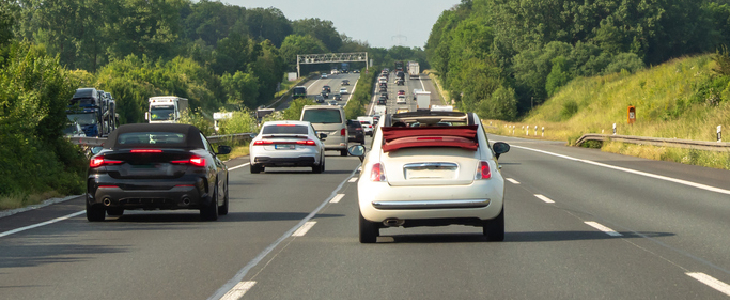
When two vehicles travel toward each other and collide front-to-front, the speeds combine into a single impact. Two cars at 50 miles per hour produce the equivalent force of a vehicle striking an immovable wall at 100 miles per hour. The frontal crumple zone, the steering column, and the engine compartment absorb only a fraction of that energy before it reaches the occupants.
Head-on collisions account for approximately 10 percent of all fatal crashes in the United States, despite making up only about 2 percent of all crashes (NHTSA). They produce a disproportionate share of severe injury and fatal outcomes because the energy of the collision reaches the occupants directly.
Dashboard impact drives TBI. The forward momentum of the occupant’s head meeting the dashboard or steering column at combined closing speed produces injury patterns not seen in lower-energy crashes.
Steering wheel impact causes chest trauma, internal organ damage, and rib fractures that puncture lungs. Seat belt loading at high closing speed causes spinal injuries and abdominal organ damage even with proper seat belt use.
Foot well intrusion produces lower-extremity fractures and amputations that are characteristic of head-on impacts, where the engine compartment collapses into the occupant space.
The bilateral force distribution across the chest and the abrupt deceleration produce spinal injury patterns that develop or become measurable in the weeks after the crash, requiring careful medical documentation.
At highway speeds, often involving a driver who is intoxicated, impaired by medication, or experiencing cognitive impairment. Wrong-way crashes on I-75 and other Macon highways tend to be catastrophic.
On two-lane roads, a drowsy or distracted driver drifts into oncoming traffic. Rural roads through Bibb, Houston, Monroe, and Crawford counties carry significant head-on risk because there is no median or barrier to prevent crossover.
In no-passing zones, around curves, or at the crest of hills, where the passing driver does not see oncoming traffic until it is too late.
Lane departure due to sudden tire failure, brake failure, or a sudden medical event behind the wheel. Less common but a recurring cause that shapes the liability investigation differently from driver-error cases.
The first work in a head-on case is reconstructing what put the at-fault driver in the wrong lane. That answer is rarely visible from the crash report alone.
In the head-on collisions we have represented, the cases that produce strong recoveries are the ones where investigation begins immediately and physical evidence is preserved before the vehicles, the road markings, or the witness accounts become unavailable.
We pull the official Georgia DOT-523 crash report and review the officer’s narrative for what was recorded and what was missed. We engage accident reconstruction experts to analyze impact angles, vehicle damage patterns, and roadway markings. In wrong-way and centerline-crossing cases, the physical evidence often establishes lane departure independent of any disputed witness account.
We pursue intoxication evidence when the facts suggest it: 911 calls, hospital toxicology, witness observations of erratic driving before the crash, and the responding officer’s notes on driver behavior. When intoxication is established, punitive damages may apply under Georgia law, and the value of the case can shift substantially.
We pull cell phone records and vehicle event data recorder information when available. Steering input data shows who turned across the centerline. Closing speed data calibrates the injury severity claim. Throttle and brake patterns in the seconds before impact often establish whether the driver was attentive, asleep, or impaired.
We work with treating physicians to document injuries in the geometry of the head-on impact. Linking each injury back to the head-on impact mechanism is what supports the damages claim later. Whiplash, concussion, and disc injuries often develop or become measurable in the weeks after the crash.
Wrong-way driver liability is rarely contested at trial because the lane position is hard to dispute. Most disputes shift to damages and the conduct of the at-fault driver before the crash.
Head-on cases hit policy limits more often than other crash types. When the at-fault driver’s primary policy is exhausted, the case turns on UM/UIM coverage, umbrella policies, and the assets of any commercially involved party.
Insurance disputes show up earlier and more aggressively in head-on cases because the carriers see what is coming. Having a firm with trial experience changes how those negotiations proceed.
In ordinary auto cases, punitive damages are a possibility. In DUI head-on cases, they are an expected component of the demand. Georgia juries treat intoxicated wrong-way and centerline-crossing drivers as the conduct that punitive damages were designed to address.
Wrongful death claims arise more frequently in head-on cases than in any other auto crash type. The damages framework, the filing rights, and the procedural rules are different from injury cases, and they shape the case strategy from intake.
When wrong-way driving combines with intoxication, dram shop claims against the bar that overserved the driver are more often viable. When a commercial driver crosses the centerline, the investigation looks at hours-of-service records and driver fatigue, with employer liability following the FMCSA framework. Head-on collisions do not just produce more defendants on average — they produce specific defendants tied to the crash mechanism. If your collision involves issues beyond head-on dynamics, a Macon car accident attorney at Gautreaux Law can review the broader picture.
Head-on cases settle more often when the at-fault carrier knows the firm representing it is willing and able to try the case to verdict. Gautreaux Law has tried cases in courts across Georgia, including Bibb County and other Middle Georgia jurisdictions.
David Cooke served two elected terms as District Attorney for the Macon Judicial Circuit and has tried more than 150 jury cases. His prosecutorial experience with intoxicated and impaired drivers shapes how the firm investigates and presents head-on cases where intoxication is a factor.
Clients work directly with the attorneys assigned to their cases. In head-on cases, where the stakes often involve catastrophic injury or wrongful death, that direct access matters. Jarome Gautreaux meets with families in person, returns their calls, and stays involved from the first consultation through resolution.
Each case is different and depends on its specific facts and circumstances. Past results do not guarantee a similar outcome. These figures represent gross recoveries before deduction of fees and expenses.
"*" indicates required fields
778 Mulberry Street
Macon, GA 31201